Thursday, November 15, 2018

You don't stop having fun when you get old, you get old when you stop having fun

We are really getting into this Canarian island life.........sandy beaches, smaller cities and towns, and scenic drives around the volcano formed islands. Gran Canaria seemed like a step up for us from Tenerife which we also enjoyed.  Our base for the 5 days was in Arinaga, a small seaside town on the south-east end of the island. From there the southern sandy seashore began leading to over 50 km's of different beaches that we could access by following a shoreline road with terrific views along the way, especially when the road we took left us clinging to the sides of cliffs.

Upon our Gran Canaria ferry arrival we made a short stop in Galdar to visit the historical Cueva Pintada ("Painted Cave") archaeological museum. The middle of the city site wasn't discovered until 1862 and only taken seriously in the mid-1900's. By then buildings had been erected on top of the former Guanches village. Excavation work is still underway and the museum does an excellent job (videos and guides) of explaining the history and lives of the islands' first inhabitants.

Our first full day was spent at Playa del Ingles (near the resort town of Maspalomas), a wide, long beach backed by sand dunes, with restaurants at the back of the beach. The ocean water was warm enough to enjoy after heating up in the sun on our beach loungers. The beach was filled with mostly Europeans seeking warmer temperatures, and consequently as you walked further along the beach away from the food and drink shops you started to realize that clothing was optional. I knew it was time to tun around when I reached the point where all clothing seemed unnecessary........tops and bottoms for both men and women.

Arinaga was also a handy spot for heading inland into the mountainous centre of the island. We started a circle tour but only ended up making it half way because we stopped too many times to admire the picturesque views and have short walks around pretty little towns. The old hillside colonial town of Teror was a hit with us and the most incredible viewpoint we stopped at was La Degollada de Becerra which featured views of both island rock pinnacle landmarks (Roque Nubla and Roque Bentayga) as well as the ocean in the distance. Once again the high elevation drive was much more relaxing and scenic for the navigator than it was for the driver who also had to watch out for hundreds of motorcycles who seemed to be out on some sort of a poker run and in a hurry to get to their next destination because they spent too much time drinking beer at their last stop. Some of their passes seemed very reckless.

We spent another day in Las Palmas, the capital city of Gran Canaria, and largest city in the Canaries with a population close to 400,000. It is located at the north end of the island and the peninsula top end allowed for an easy walk to both the east and west side shorelines where we could walk along a lovely promenade. There were many restored colonial buildings making for nice views along the way. A highlight was a visit to Casa Colon which hosted Christopher Columbus several times on his four voyages across the Atlantic to the Americas. The former small palace now houses a museum that did a wonderful job of detailing his 3 ships, his courses for each trip and the challenges he and his crew faced. From my school days I remembered that his original journey was intended to find a shorter route to the Orient and the Americas (South and North) were discovered by accident, but I should have been paying more attention to learn and remember about the rest of the incredible voyage details.

Today we took another ferry to the island of Fuerteventura where we will spend several more days.

After our ferry landing in Puerto de la Nieves on Gran Canaria, we walked around the small town and came across this tiny church. Being a fishing port (now) and a starting point for exploratory voyages in the past, take note of the ships on the walls and in the rafters where many prayers would have been offered in hope that everyone would return home safely.

Every time we are in a fishing village I am always on the lookout for one of my favourite meals......fresh, small fish., sardines in this particular case, while in Puerto de la Nieves.

The Cueva Pintada archaeological site in Galdar. The Painted Cave was underneath some of these former homes and is now closed off from the light to help preserve the art which had been fading over time. A museum guide opened the locked door to let us in and explain the history.

We spent most of the day at the beautiful Playa del Ingles beach in Maspalomas on the southern coast of the island.

The la Degollada de Becerra viewpoint where we stopped for a car snack during our drive around the mountainous interior. The Roque Bentagya pinnacle is on the left and the island of Tenerife in the distant background.

A view of Las Palmas, the largest city on the island. Our drive was filled with views like this all along the way.

The lovely town of Teror where we stopped into during our interior drive so that we could stretch our legs.

The interior of the Santa Ana Cathedral in Las Palmas. We were fortunate to find the organist practicing while we were there with the soft, melodic chords filling the entire Cathedral.

Behind the Cathedral we found the Casa Colon where Christopher Columbus spent time before his voyages to the Americas. As soon as his ships were loaded with months worth of supplies, and final repairs / alterations made to his ships then it was time to start the long voyage and pray that the earth really was round and not flat.

While walking along the Las Canteras beach promenade in Las Palmas we came across some detailed sand sculpting.


Thursday, November 8, 2018

When Your Day Starts Out Brilliantly and then it Starts to Rain

Our Canary Islands adventure got off to a good start on the island of Tenerife. We spent the first full day walking around the capital city of Santa Cruz de Tenerife and the attached (original capital) city of La Laguna, where we decided to base our activities. There is a tram system between the two that works very well, and we used that to move around both places which were very walkable, although slightly slanted towards the water. The pedestrian-friendly La Laguna downtown area, with it's colonial charm was our favourite of the two.

The next day we drove around the island with our rental car. None of the Canary Islands are large, and we mixed in about 4 hours of driving with 5 different stops totaling the same. The hairpin turns at the south end of the island made for incredible cliff side views for the navigator, while the driver was consumed with the narrow road and oncoming traffic. Many viewpoint stops allowed both of us to relax and enjoy the vistas. Puerta de la Cruz, with it's seaside walls and picturesque streets was a fave, along with Playa de las Americas with it's lively waterfront promenade and spots to relax with a drink and enjoy the atmosphere.

We saved today for our drive to Mount Teide, the highest peak in all of Spain and the 3rd highest volcano peak in the world (behind Hawaii's two), near the south end of the island. The sky was totally blue and we envisioned views from the top of the crater that would allow us to see all seven of the Canary Islands. The road there was fabulous.........wide enough for two large vehicles to pass one another, nicely paved and with a gradual climb from the sea that did not involve switchbacks. The views were incredible along the way, with viewpoints showcasing shorelines on both sides of the island. Then the trouble started. We arrived at the cable car station.......I had discovered a day earlier that hiking up required a special permit.......to find a multitude of other vehicles all searching for a parking spot when the few scattered lots around were all full. Similar to our national parks they do not want to encroach on the land, which in this case is filled with lava rock. It took us an hour to find a parking spot until we tripped over a vehicle about to depart. It became obvious that they need to consider making a change like the NP does in Zion (Utah) and other popular places we have ventured to, where they create a large parking lot away from the precious land and then bus visitors in and out to avoid the mayhem. We then walked about a kilometre up a hill to the station, only to find out the cable car was sold out for the day.......before noon! It kind of reminded me of our Taj Mahal experience in India. Once again we made the best of a bad situation which was not hard to do with an incredible volcanic landscape around us. We drove a bit further along to Roques de Garcia where we were able to walk amongst lava pinnacles which had outlasted the terrain around them. The Visitor Centre had a descriptive video of the island's creation and volcano history (English headphones) which soothed our sad souls. The one hour drive back to La Laguna was just as enjoyable as the drive out.

Tomorrow we will leave Tenerife and take the 80 minute ferry to Gran Canaria where we re-start our engines.

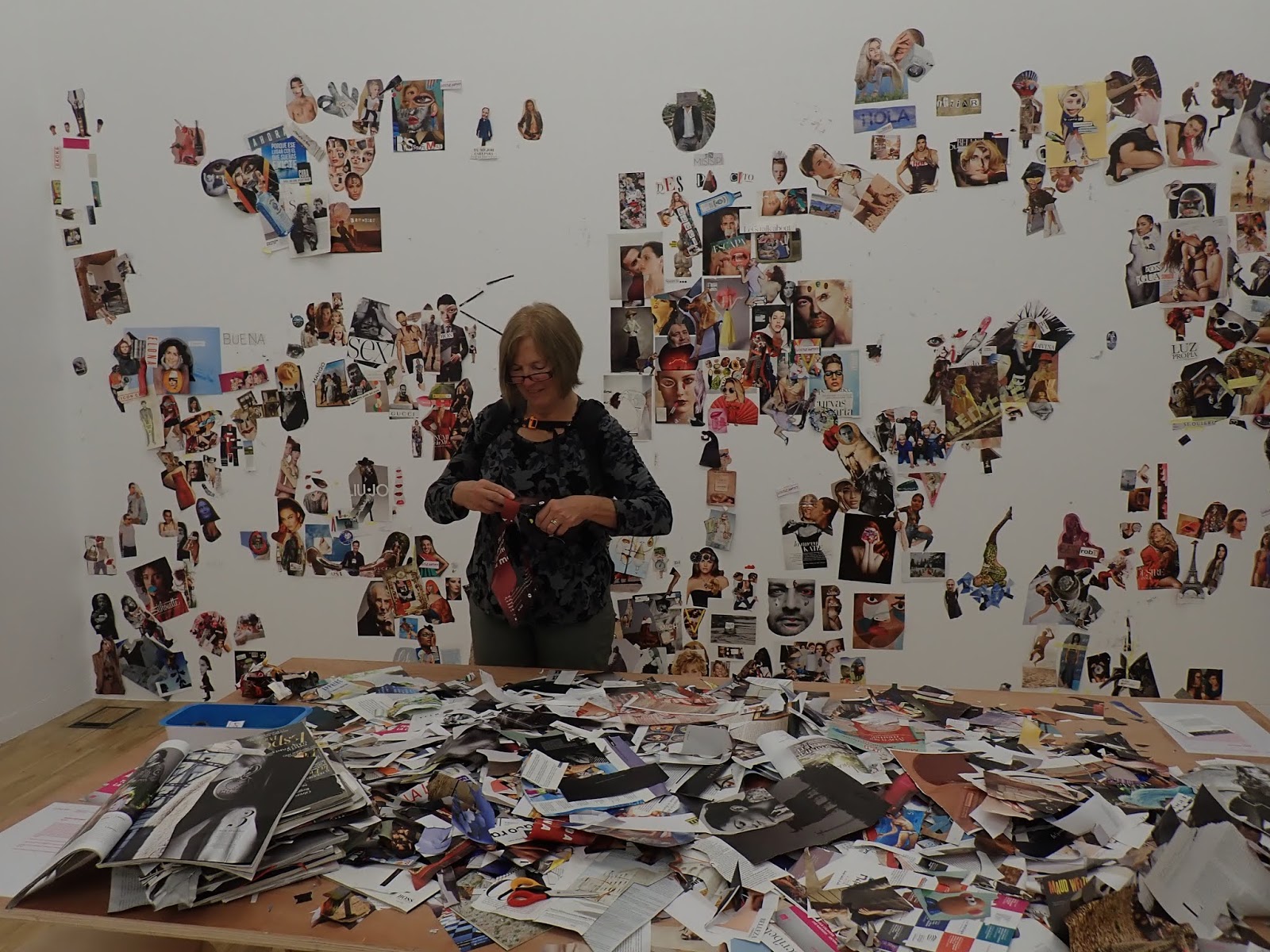
My bride at the Museum of Modern Art in Santa Cruz de Tenerife trying to create her own wall masterpiece. Actually, it was a collection of old magazines, with scissors and glue available for visitors to create their own tiny, creative piece of art. it was interesting and fun to view how different people's minds worked.

Looking back at Plaza Europa in Santa Cruz while walking one of their pedestrian-friendly streets.

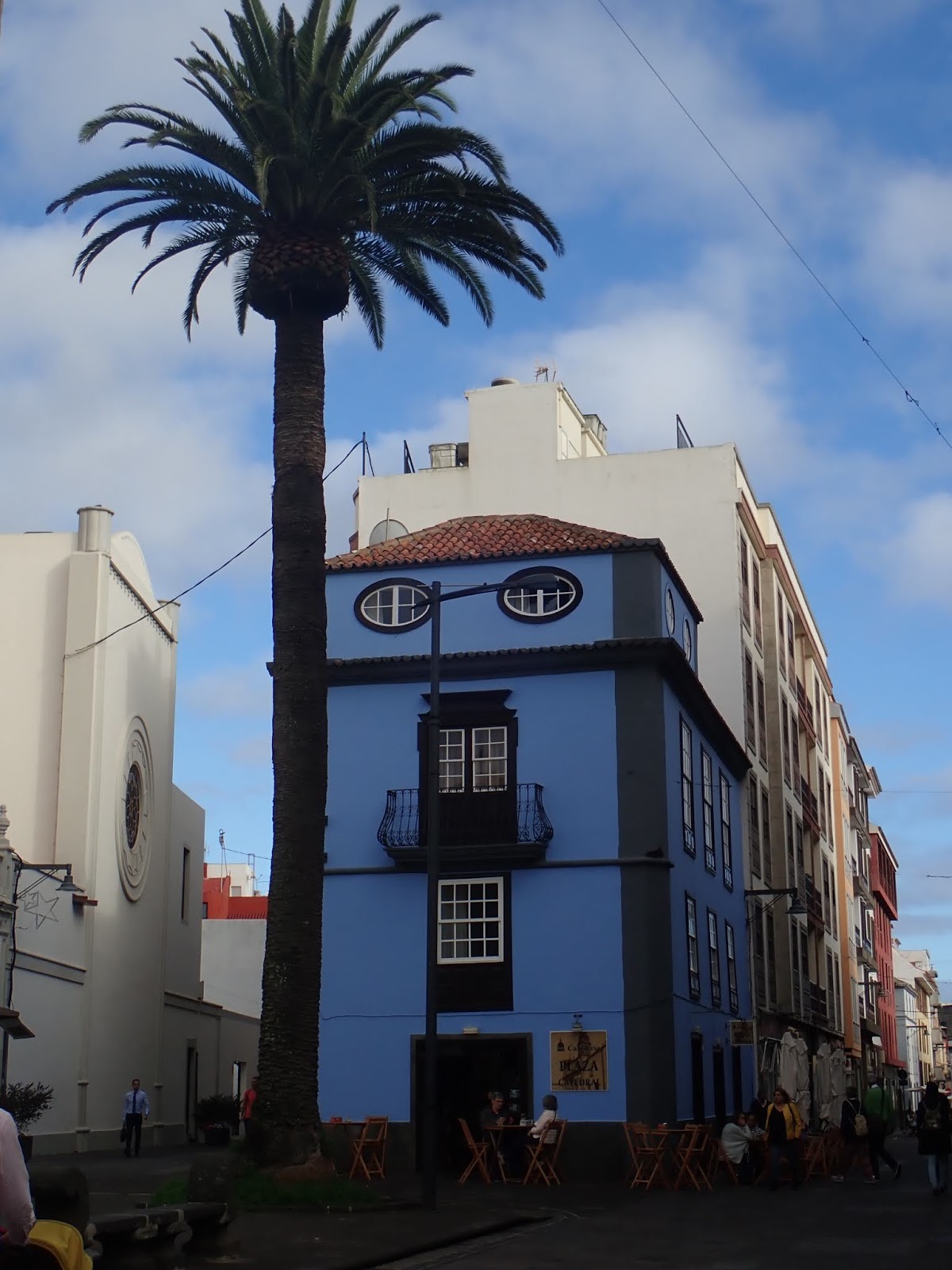
We fell in love with this building in La Laguna while walking around. Did you already notice the mustachioed face resemblance they have created?

While in La Laguna I had a tasty pulpo (octupus) dinner, almost as good as my Camino de Santiago meal a few years ago.

Our drive around the island of Tenerife began with this wonderful view of Mount Teide above the clouds.

The fascinating seafront of Puerto de la Cruz on the west side of the island. It was easy to walk around with many sights and left us wondering if we should have chosen this city as our base.

At the point where I decided that my driver needed a break from the narrow road hairpin turns at the south end of the island. This hill seems to be collapsing one small segment at a time. I would certainly be worried if I owned a property at the base of the hill.
Your greeting when you arrive at the ticket window for the cable car to the peak of Mount Teide. In whatever language you prefer, it is not the news you were hoping for.

The view a short distance from where we parked (bottom left) to get to the cable car. They really need to do something about the access since interest in Mt. Teide is growing almost as fast as the frustration level of the visitors. I can envision another eruption happening soon, but this time at the base of the cable car station.


Y

Roques de Garcia - the lava pinnacle on the right is called The Cathedral. A smaller volcano once existed on this site and the pinnacle is the hardened lava which emerged from the centre of the volcano and outlasted the surrounding terrain around it.

Saturday, November 3, 2018

From One Extreme to Another

We recently moved from Marrakech......the wildest medina in Morocco......to Essaouira where there is a laid back atmosphere in a beach and fishing village on the Atlantic coast. It is quite a contrast, and one that we don't have a problem with as we finish off our 3 weeks of travel in this country. Marrakech is famous for it's Jemaa el Fna main square where during the day you will see snake charmers with their cobras and captive monkeys for your entertainment.......if you see it that way. In the evening the performers change to musicians, dancers (male) and story tellers, with the square becoming even more crowded. At least a hundred food stalls with seating appear out of nowhere into the centre of the square and a party atmosphere emerges (without any alcohol). It is quite a spectacle. The souks (market areas) within the medina are also crazy busy with every vendor letting you know they have the best prices on their wares. It was fun for a few days but it was also a nice change to arrive in Essaouira with it's long and wide sandy beach, fishermen going about their daily routine, and a smaller medina where the shopkeepers were not nearly as aggressive (relatively speaking). The temperature has been lovely here.....mid-20's and sunny but it has also been windy so we haven't spent any time lounging on the beach with the blowing sand. Our riad however has a lovely terrace outside of our room with walls blocking the wind and a nice place to retreat to. Our biggest stress point here has been to make it in time to a fabulous restaurant we have discovered......Restaurant Adwak, second only to Cafe Corner in Marrakech.....where a line-up begins before the restaurant opens at 7 pm and the patrons at the back of the line-up do not get into the small restaurant until late in the evening. Since this is basically our last stop in Morocco we have made a few purchases to bring back home. The main item was a Moroccan carpet (runner) which required time in many shops and a great deal of bargaining before arriving at a price that was acceptable to both parties (a national spot in this country).

Before Marrakech and Essaouira, we spent 3 days in Casablanca......home of the famous Humphrey Bogart, Ingrid Bergman movie.........which was entirely filmed in Hollywood! We did have a nice lunch at Rick's Cafe, an upscale restaurant featured in the movie.......and built years after the movie became famous! There were two main highlights for us. The first was having our Swiss daughter and her partner join us for 4 days, and our tour of the Hassan II Mosque, one of only 2 mosques in Morocco that non-Muslims are able to enter. It was a treat to find out what goes on inside the walls and a group guide did a good job of explaining both the magnificent mosque and the religious rituals. The other oddity that occurred while were in Casablanca was that the Moroccan government made a snap decision 48 hours before the clocks were scheduled to be turned back, to not observe Daylight Savings Time, after doing so in previous years. It led to all kinds of confusion on the actual time when pre-programmed time changes happened anyways (including Google) and airlines had to send out messages about flight changes to reflect the proper time. There would have been many people, especially travellers that missed the news, who got messed up with their bus, train and airplane schedules.

Tomorrow we will take a bus from Essaouira further south along the coast to Agadir where we will spend a single night before flying from there to the Canary Islands. Time to start practicing our Spanish again.........and how to consume alcohol!

The Hassan II Mosque in Casablanca. It doesn't appear to have many visitors but there were more than 200 hundred of us waiting for prayers to finish so that our 3 pm tour was allowed to start.

The purification area in the basement where worshipers cleans themselves before going upstairs to pray. The fountains were turned off for the gringo tour.

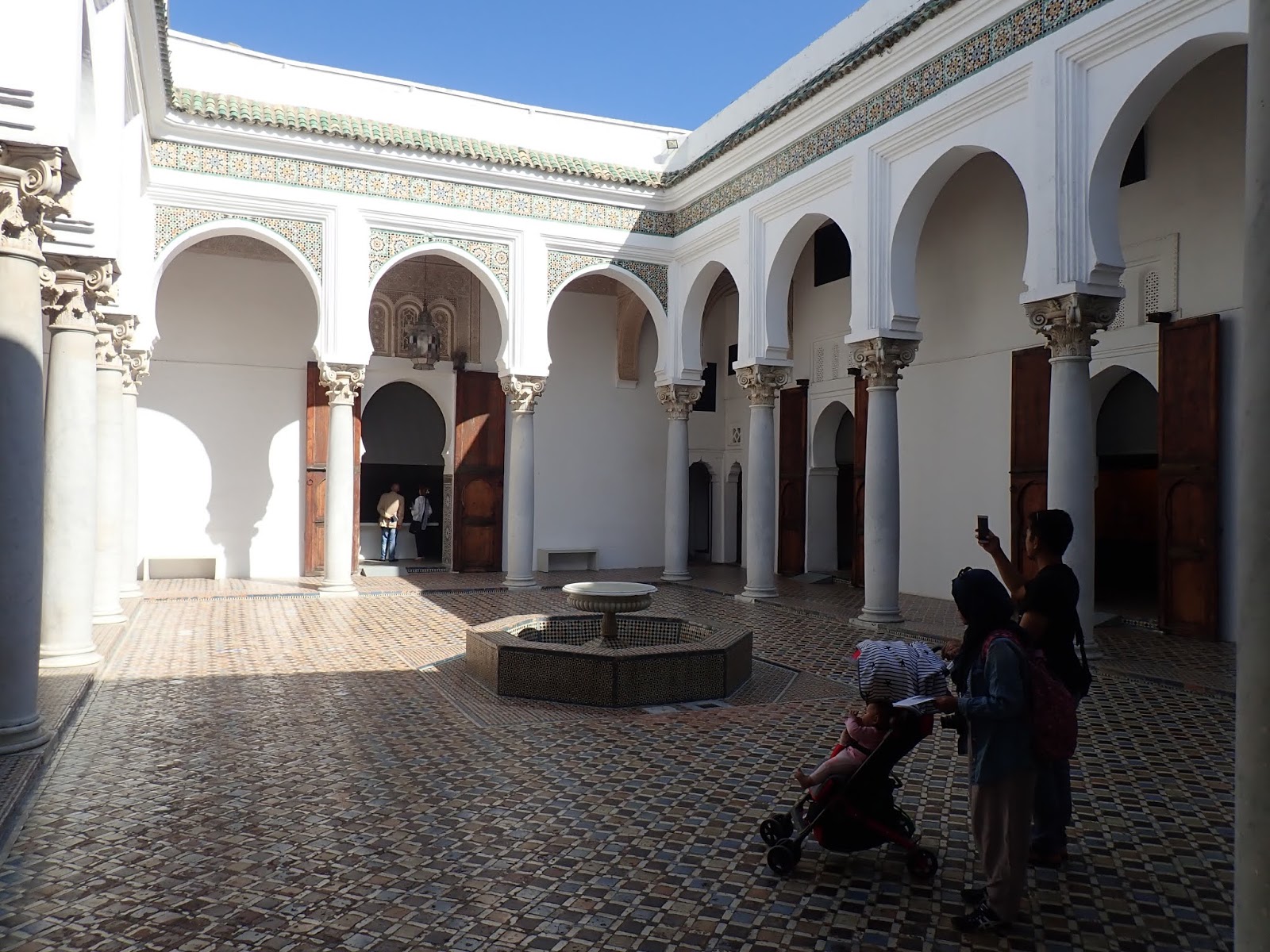
The courtyard of the Dar Si Saad Museum in Marrakech which featured Moroccan artistry especially their mosaics and carpets.

View of a spice shop from a terrace in the medina.

Intricate design inside the Saadian Tombs where a famous Sultan and some of his elite friends were buried.

The El Baddi Palace which is still in remarkable shape having been built in the late 1500's.

A corner of the active Jamaa el Fna square in Marrakech which undergoes an amazing transformation at night.

A pleased haggler who bargained for a long time to get her tassles down to $19 from a starting point of $100.

The Ramparts in Essaouira. The only thing they are protecting right now is the lovely sand beach on the opposite side of the point from the strong Atlantic waves coming in.

The multitude of fishing boats at the harbour, with the serious ocean boats grouped at the far end of the port.

Thursday, October 25, 2018

Why Can't We Be Friends?

The jury is still out on our romance with Morocco. After 10 days in this country we have a mix of feelings, some good, some not so good. While their history is interesting and encapsulated in the lovely architecture of their mosques and former palaces, each of the four cities we have visited so far seem to mirror the others, and beyond the inability to access many of their treasured buildings (closed to non-Muslims) we have come across some inbred personal behaviours that are not attractive for a country trying to lure in tourists. We have still met many nice people along the way but it has taken us longer than normal to trust strangers who approach us because of the other half who attempt several different strategies to try to scam us, more so than any other country we have travelled to. Hopefully our negative first impressions will be a faded memory by the time we finish our 3 weeks here.

Since we left you last, we have been to Fes, Meknes and Rabat/Sale where we are just finishing a 3 night stay. All 3 cities featured a busy medina (old walled town) within a larger city. The medinas feature former palaces, numerous ancient mosques and many souks (market areas), all contained within a labyrinth of narrow alleyways. They are interesting to visit but it is often difficult to get around with so many people moving in different directions and suppliers bringing in goods on carts or mules. Fes highlights included the Chouwara Tannery where we were able to watch animal skins going through the process of cleaning, dying and drying, and Place de Seffarine where coppersmiths made beautiful copper and brass items in the middle of a small square. In Meknes, we made a day trip to Volubilis to see some Roman ruins that dated back to the first two centuries. Our private driver for the day, a taxi we shared with a nice Spanish couple, also drove us to the holy Muslim city of Moulay Idriss where we had a delicious meal on a rooftop terrace overlooking the city. In Rabat we decided to find lovely riad accommodations (bedroom in a renovated older home) across the Oued Bou Regreg River in Sale. We are moving back and forth between Rabat and Sale either using their new tram system (above ground light rail transit), or today via a rowboat taxi service for .35 cents each. The Mohammed V Mausoleum (former king's fancy burial site) and a massive unfinished 12th century mosque and minaret tower were featured.

Tomorrow we will be moving on to Casablanca using the ONCF train system which has worked well for us so far. We know Casa will be a highlight for us because our daughter Rachel, and Pascal, will be flying in from Basel to spend 4 days with us.

Comfortable travel in our first class seats. Fortunately for us, 4 other people didn't book into our 6 person compartment for the 5 hour train ride, which only cost $23 pp.
The Chouwara Tannery in Fes. The animal skins first go into the white coloured tanks (lime, salt, water, pigeon feces) for 2-3 days to soften up the leather. Then they are moved to the coloured tanks to absorb the dye colour, and finally dried before being made into a purse, shoes, jacket, etc. It is a total manual process as it has been since medieval times.


Walking through the Fes medina with the shopkeepers waiting for someone to take a glance at their products. There were no empty stalls in the medina so they must all be doing well. There were quieter and even smaller side alleys leading to homes and a potential shortcut to your destination......if you were lucky enough to find your way out of the maze.

Place de Seffarine in the Fes medina. There there were tools in the small square that the coppersmiths shared to make the goods that were for sale in their stalls.

The site of the Volubilis Roman ruins which dated back to the 1st century. The local tribes let the Romans have their way for 3 centuries and when they had finished building the city, they moved in and took over a place that was too far away from Rome to defend.

One of the many tiled floors still in relatively good shape in the former housing area at Volubilis.

The Muslim holy city of Moulay Idriss. It was considered so holy that non-Muslims were not allowed to visit the town until 1912, and they weren't allowed to stay overnight until 2005!

This is the main lobby area of the riad that we are staying at in Sale, the twin city of Rabat. On each side of the pool there are welcome areas and dining tables. The bedrooms are upstairs (2 more floors, 4-5 rooms in total) and above that is a rooftop terrace for relaxing or dining. It is similar to the other riads we have been enjoying for our overnight stays.

The Mohammed V Mausoleum which has guards at all the doors on the above floor where the viewing takes place. My wife has told me to expect much less.

The Madersa des Merenids in Sale. A madersa is an ancient school for young people to be introduced to Islam. While the tile work and mosaics were exceptional (in all the madersa's we have visited so far), the rooms above where the students slept were tiny, windowless and similar to a jail cell.....an interesting way to spend money.

A look back from our rowboat of the Rabat Kasbah  (ancient fortified area for an elite neighbourhood) and the Le Dhow galleon where we had lunch following our walk through the medina and kasbah. The galleon was built in India in 2008-9 and then brought to Rabat to serve as a riverside restaurant.

Wednesday, October 17, 2018

My Woeful Attempt to Rock the Kasbah


It has only been a few days since we arrived in Morocco but I thought it was time for another post. I will let you decide at the end if this is really an update or a bit of a rant.

Rock the Casbah.....spelled with a C instead of a K for some reason, perhaps it was the drugs......was a 1982 hit song written by the Clash, written in response to a late 70's ban on western rock music in some Arab countries. The ban was largely ignored by the Arab population who continued to play the music in their homes and even by the armed forces who were tasked with policing this 'offensive' behaviour. Gradually, even the Shah or rulers at the time became enchanted with Rock & Roll music, like we all are, and the severe penalties were repealed although rock music is still not 'encouraged' in most public places. My chance to rock the Kasbah.....a special fortified palace in the old walled city......was diminished by forgetting my boom box at home, which now meant I had to go out to one of the clubs at night. However, they do not seem to open here until 10 pm, and get rock'in until midnight, which is way past my bedtime, so that is not working out so well for me. We did get to visit the Kasbah in Tangier but I cannot really say I rocked it. However we did enjoy it anyways with it's well laid out museum inside.

We tend to book our accommodation on these trips close to the places we want to visit since we carry our backpacks with us and prefer to walk everywhere we can once we get there. In the case of older countries that is generally close to the old city, either just inside the walls or very close to them. In Morocco the old city is called the 'Medina', and in Tangier where we have started our adventure, our hotel is just inside the walled city. The original town planners in this country did not do a very good job (in my opinion). There is no such thing as a straight road or a grid within the medina. It is a complex labyrinth of winding narrow streets and alleys that are guaranteed to get you lost in an instant. No need to worry though....if you pull out your map, or your device, or even hesitate for a few seconds, you will immediately be approached by a local offering their assistance to get you where you really want to go........for only a few dirhams in exchange (less than a dollar). I have decided to treat this like a puzzle. When I challenge myself with Master Sudoku puzzles which I enjoy, getting a hint by looking at the final solution at the back of the puzzle book would be akin to soliciting the help of a local over here. So I am now expecting to get helplessly lost in the medinas and will be challenging myself to successfully find my planned destination. Hopefully my bride will still be at my side, or at least still smiling, when I emerge from the maze. Today, that worked out quite well covering off both the Upper and Lower Towns with the medina (yesterday as newbies, we did not fare so well).

We have been to India and other countries where alcohol is not always readily available but this is our first foray into an Arab country where alcohol is forbidden in public places. Apparently there are a handful of places in each city where alcohol can be purchased but none of them exist close to the medinas where we like to stay. If we were to take the trek, or a taxi, to one of these rare places, then we would only be allowed to consume it within the confines of our room. That kind of rules out beer since the rooms here do not come with fridges or mini-bars.......unless you like to drink warm beer which I don't. The reviews I  have read on Moroccan wine are not very good.......but we did seem to slowly acquire a taste for Retsina when we were in Greece and it was the only wine available, so there is some hope there. For now we have started with 'mint tea' which seems to be served everywhere. It is a concoction of sweet tea with fresh mint on top, delivered to your table in a steaming hot glass which requires hot mitts to pick up. However, if you let it sit for five minutes then you can gingerly pick it up at the very top of the glass with two fingers and have a sip. Eventually it warms up and you can finish it off. Meanwhile you will have spent most of your time thinking about how wonderful a cold beer would have tasted after spending a hot day walking in and out of the maze. I did notice some locals at a table beside us drinking their 'tea' from a teapot which brought back some old memories.....on election day many years ago, alcohol could not be served until after the polls closed. However, if you were a good patron of a local bar you did get served your drink of choice in a teapot so that you could pour it into a teacup without anyone else noticing. I suspect that may be going on over here, or perhaps it is just my imagination working overtime again.

While I am on a roll, you don't need to set your alarm over here if you wish to get an early start on the day. At dawn each and every day you will be awoken by the Islamic chanting call to prayer which is broadcast in surround sound from loudspeakers throughout the city. There are as many mosques here as there are Catholic churches in Italy, which is how they can easily provide surround sound to every single residence in the city. I have not figured out a solution to that one yet. Fortunately for us, we rarely get too far ahead of ourselves in making advance reservations, in order to maintain flexibility in our schedule thus enabling us to take advantage of new route suggestions offered to us or remaining in a place a bit longer than we originally wanted to. That means in the near future I can start narrowing my search for accommodations.........a soundproof bunker with a fridge and close to one of the rare stores selling alcohol. I will keep you posted on how that works for me going forward.

Despite what you might be thinking by now, we really are having a good time so far. The Tangier medina is fascinating to walk around even if you are not quite sure where you are going. Incredible history, buildings that have survived longer than our country has existed, interesting and tasty street food available at every turn, watching the odd vehicle attempt to make it through the crowded and narrow streets, busy markets selling food items we are not familiar with, and lots of shopkeepers pretending they are our new best friends. There is not a lot of English spoken here.......except for some common phrases like “let me show you the way”, “taxi?”, “please come into my shop”..........but beyond Moroccan Arabic, of which I can only seem to remember “shukran” (thank you) and several more words, the Moroccans seem to have a good grasp of French which we also remember from our early school days, at least enough to get by.

Just before we arrived in Morocco, we spent a day in Gibraltar. After heading out to Europa Point at the southern point of Gibraltar where you could see both Spain and Morocco across the Strait of Gibraltar, and likely more countries on a less hazy day, I climbed up the Mediterranean Steps to the top of The Rock. Rather than climb the 4 km steep route of steps and path, Pocahontas settled for the cable car to the top. It was a good workout for me with beautiful views along the way, although I had to careful not to join the throng of other tourists at the bottom of the cliff who might have missed a step admiring the view and plunged to their tragic end (editor's note: this might be fake news). Anyway, I made it all the way and we had a celebratory drink at the top. We walked back down together, but on the less steep west side facing the city so that we could stop along the way to visit the many war time exhibits including batteries, temporary shelters and tunnels built just inside the cliff wall for cannon placements. The main street of Gibraltar is pedestrian-friendly as was Casemates Square. There was a quick passport check where the only requirement was to hold your passport in the air as you walked from Spain into and out of Gibraltar.

The next day we took the one hour ferry from Tarifa, Spain over to Morocco. Once again it was a light security check (backpacks only, through a metal detector) and a quick passport stamp during the ferry trip. Once on shore we were able to walk the kilometre or so to our hotel in the medina.

Tomorrow, we are leaving Tangier and taking a 5 hour train ride deeper into the heart of Morocco, arriving in Fes where we will spend several days getting lost again within their much larger medina.


The Rock taken from Europa Point at the southern shore of Gibraltar. The mosque had the unusual name, "Mosque of the Two Holy Custodians". This view of the 4 km. hike to the top changed the mind of one of the two participants in my group.

Came across this small family of Barbary macaques near the cable car station at the top. I later discovered that the 300 or so in Gibraltar are now the only wild monkey population left in Europe. Since they are not hunted here and live in a Nature Reserve, their population is actually growing which is in contrast to Africa troops (hunting and deforestation).

View from the top of The Rock. The city of Gibraltar is on the bottom left and La Linea de la Concepcion, Spain on the right across the water. In the middle is the Gibraltar air strip which runs out into the water. When you cross into Gibraltar from Spain you actually walk across the centre of the airstrip. When we arrived the barrier was down and we had to wait until a plane took off before we could walk across the airstrip.

Walking through the shop portion of the medina in Tangier. This might have been the straightest stretch of pavement in the entire medina (old town).

Our freebie appies that were served before our first rooftop meal in the medina......lentils, green bean puree, olives and hot sauce. A good start to a great meal.....although a glass of wine would have been a nice accompaniment.

A good view of the Tangier port from the Upper Town within the medina. The Atlantic Ocean is on the left and Spain is on the other side of the Strait of Gibraltar which leads into the Mediterranean Sea.

This is one of the inner courtyards of the Kasbah with a lovely tiled floor. It is now part of a museum which does a good job of explaining the history of Morocco in terms of how it got it roots from many parts of Europe, the Middle East and Africa.

The Grand Socco indoor market where the locals often shop for their food.
r

Sunday, October 14, 2018

Back In My Happy Place

It's not that I am unhappy at home.....far from it.....a wonderful family, great friends, nice neighbours and a busy and active life.....it's just that world travel takes it up another notch. Visiting places we have never been to before, experiencing different cultures and meeting happy people who live their lives quite differently than we do. It provides an interesting perspective and definitely keeps one thinking about the big picture and world events rather than existing within our comfortable bubble.

Our adventure this time will focus primarily on Morocco and the Canary Islands. We started off with a very short stay in Madrid to catch our breath, followed by a train ride south to Cordoba where we have been for the past 3 days. Finding it very difficult to get accommodations, we ended up staying in both a hostal and a pension for our 3 nights. Upon arrival at our hostal we discovered the main reasons.....Friday was a national holiday (Fiesta Nacional de Espana celebrating Christopher Columbus' landing in America but I suspect these days the Spaniards are just happy for a long week-end) and the International Game Festival which was taking place during the upcoming week-end, scooping up almost every available bed in the city. Being game lovers ourselves, one of our first stops was over to the beautiful Palacio de la Merced which was hosting the event. We were pleased to discover that the large, packed room was full of board games rather than video games (showing our age, perhaps). Hundreds of different games were being presented, many being relatively new games trying to expand their market. Representatives from each of the games were at tables instructing mostly young people (30 and under) how to play their game and then letting them try it on their own. It was fascinating to watch them laugh and play while interacting with other participants rather than being self-absorbed in a video game with no social interaction. Perhaps board games are making a comeback and a crowded room with the younger generation provides some hope.

We enjoyed our time in Cordoba, spending our time in the older part of the city which was easy to walk around with many pedestrian friendly streets and narrow winding alleys discouraging vehicle traffic. The alleys provided plenty of shade to help us manage the 30C temperatures (above normal). The prime must-see spot was the Mezquita which dates back to the 7th and 8th centuries, currently a Cathedral but previously a Mosque and a church before that. Every time it was taken over by a new religious faction it was enlarged and made even more beautiful as a show of power to the point where it can now hold over 40,000 worshipers. The clash of Christian and Islamic architecture was interesting to see. The line-ups to get in were long but once inside there was plenty of room for the crowd to disperse and it was easy to walk around with our audio guides explaining the history and the meaning behind each of the treasures within.

Other Cordoba highlights included the 16th century Palace of Flowers with it's 12 different beautifully designed courtyards. The abundant flora and well-fed fountains provided a cooler environment for the 16th century aristocratic residents in the summer heat. The 1st century Roman Bridge crossing the wide Guidalquivir River, the Alcazar de los Reyes Cristianos (1328 palace and fortress) and the Plaza de la Corredera, a former bullring and public execution spot now transformed into a large public square also got our attention. The clock tower in the main square played a short guitar riff before the bells rung but I was left wanting for a Jimi Hendrix riff or one from any of my classic rock buddies.

This morning we took a 3 hour high speed train further south to the Mediterranean coastal town of Algeciras which will be our base for our foray into Gibralter tomorrow, a short bus ride away.

Adios for now.

The 1st century Roman Bridge which was the only bridge in the city for 20 centuries (albeit with a few facelifts). It appeared in the Game of Thrones for anyone watching closely, and is now a pedestrian friendly crossing.
The Alcazar gardens, part of the medieval palace and fortress.

The Mezquita bell tower. I tried to get a ticket to climb it the next day for spectacular views of Cordoba but they only allow 20 people at a time to climb the narrow stairway so I passed on the 3 hour wait time.

The International Game Festival held at the lovely Palacio de la Merced. The game instructors hung around until the participants were able to proceed on their own. There were a few card based games but none using a 52 card deck or games that we were familiar with.

The Plaza de la Corredera which was originally a bull ring but now is a popular public plaza with the former stands converted into condominium apartments.

We had an excellent traditional meal at El Rincon de las Beatillas which was bullfight crowd friendly in its' time. One room had a portrait of a famous bullfighter beside his prize for that day. My personal thought is that this should be a 2 part event. In the first part of the competition the bullfighter must ride the bull for 8 seconds (as in the Calgary Stampede). If the rider is successful then he gets to go into the ring with his sword, otherwise he enters without his sword and is fair game for the bull. Then we will see how tough they really are.

The entrance courtyard at the Palace of Flowers (Viana Palace). After visiting all 12 courtyards I suspect there might have been more gardeners employed than residents in the palace.

The fabulous Mezquita, the jewel of the city, with it's 856 columns in a Mosque built to hold over 40,000 people kneeling towards Mecca on marble floors.

The Mezquita Reconquista occurred in 1238 and the ornate Cathedral was built in the centre of the former Mosque. There was an awful lot of gold inside for gold diggers looking for an alternative to the Klondike.